Thursday, February 12, 2009
The search for Vanderbilt, Manvel and Lanfair
Vanderbilt, Calif.
A spur line of the Santa Fe Railway was built from Goff's to Ivanpah. Vanderbilt was a station on this old railroad, and also the name given to the mining district.
A United States Post Office was established at Vanderbilt on February 1 1893.
The name Vanderbilt was given to the town and the district in the hopes that it would prove to be as rich as the famous family in the East, bearing that name.
As of 1963, the railway spur has long since vanished and the ties and rails removed. The present road to Vanderbilt follows the old railroad bed for one mile. The C. C. Darling Mine still operates in the area,but not on the site of the old town. Half a dozen crumbling old wooden buildings remain,as well as some rusting mining machinery.
After 1964, the C. C. Darling Mine was sold and the entire property, including Vanderbilt is posted " No Trespassing. "
Manvel, California ( Now called Barnwell )
Manvel was another station on the same Santa Fe spur as Vanderbilt, about 5 miles South.
It was named for A. A. Manvel, President of the Santa Fe Railway. Its U. S. Post Office was established on March 30 1893.
Quite a few old frame buildings still stood as of 1963. The town was still occupied,apparently, until about 1952.
Dads trip to Vanderbilt as told by himself 1963
It took two or three months, during the early winter of 1963, to track down the location of the ghost town of Vanderbilt. I had seen the town mentioned in an index of California ghost towns, and I had been told that there was an interesting article on the old camp in a back issue of a certain magazine, but I was unable to locate that issue from the publisher. Finally, I wrote to the Mitchell's Cavern State Park people who had so kindly directed me to Providence a few months previously.
The prompt reply to my query was just what I needed. Complete with a hand-drawn map, mileage notations and visible landmarks. It not only guided me to the town of Vanderbilt but indicated that I would pass two other ghost towns on the road: the abandoned site of an old dry-farming community called Lanfair, and a mining camp named, variously, Manvel or Barnwell.
I laid my plans for a week-end in the middle of January 1963. Disregarding all warnings that the desert in that region was subject to gusty winds, below zero freezing weather and sandstorms at that time of year, I loaded the jeep ( 46 Willy's ) , with equipment for an overnight camp and, at 2:30 Saturday morning after only two hours sleep, I pointed my Four-wheeler toward the distant New York Mountains of Eastern San Bernardino County.
My clothing, that cold morning, consisted of thermal underwear, wool hunting jacket, wool sweater, fleece-lined jacket and a hooded sweat shirt, over all of which I pulled a heavy, three-quarter length car coat. On my head I wore a foam rubber-lined cap with earflaps, and of course wore heavy gloves on my hands. One might guess that my jeep had no heater, and the thin canvas top was no ways windproof.
Thus guarded against the elements, I could laugh away all the fearful admonitions of my friends and family. Was I not, by now an experienced desert rat?
I was right, at first. For the entire 250 miles to Goff's, California, near U. S. Highway 66, I rode as cozily in the drafty cab of the jeep as though I were sitting in my own living room.
Swinging North on the Ivanpah-Goff's road, a bulldozed track of dirt and gravel, I gave a self-satisfied smile as the early morning sun began to warm up the landscape. Within half an hour I had located the site of Lanfair, at the junction of my dirt road to Cima.
Here I found only old concrete foundations of buildings and a ruined water tank. I was unable to see any sign of trash dumps so, since my object was old bottles, and since the wind was a little sharp here, I left the site of Lanfair behind me and crossed Lanfair Valley until I had entered a low range of mountains.
The road had been climbing for some time, and in the hills the sky was overcast. I passed the OX Ranch without stopping, and a few miles farther, on a mountain slope to my left, I spotted many scattered frame buildings, obviously abandoned and falling into ruin. This, I was sure, must be the old town of Barnwell, or Manvel.
I spent two lonely hours here examining the ols buildings and going through the dumps. Three little brown pill bottles about half an inch in diameter and three inches long went into my pocket, as well as a sun-blued " Absorbine, Jr. bottle, a " cathedral " type bottle and several more of a similar nature. Most of these had screw caps, however, and would have little value. They would suffice to be happy reminders of the trip.
Four or five miles North of Manvel I found the little road sign I was looking for. Pointing to the hills on the right it read " C. C. Darling Mine."
This little road was no more than a couple of wheel ruts, and it ran as straight as an arrow through a deep cut in the hills. It dawned on me that this was an old railroad bed with the steel rails and wooden ties removed. Once through the cut in the hills a deep,inverted v-shaped rock and earth fill carried the road across a deep gorge.
I felt very puny as I bounced along, for the steep sides of the fill dropped sharply for many many6 feet,while the apex of the vee which carried the road, was not more than 10 or 12 feet wide. ( near the center of the gorge a slide had narrowed the track to only a little wider than my jeep! ) Gingerly I inched past this danger point, very conscious of what would happen to me and my jeep if the road gave way under us!
Crossing several more cuts and fills, always ascending, I soon found myself among the high , rolling peaks of the New York Mountains. " Rolling Peaks" is, perhaps not quite the proper description, since the hills were quite steep but there were no verticle escarpments in the area.
Higher still, and to my right, and half mile or so away from the railroad bed, I could see the crumbling shacks of Vanderbilt.
This was real four-wheel drive country, and long before I reached the uppermost building in town, I was using compound low gear.
An old tipsy-looking building, a false-front store, first attracted my attention. It presented a sad appearance,and as I crossed the threshold of the doorless aperture I felt a distinct shudder pass through the entire structure. In the main store room merchandise shelves lined two walls clear to the ceiling, and on the floor were wooden bins for the display of dried beans,potatoes and other products, after the fashion of fifty years ago. Everywhere the dust and debris was evident.
Even now, the wind was icy on my face.It entered boldly through the doors and windows, felt its way between the broken, rotting floorboards.
In the kitchen the rusting wreck of an old wood-burning stove lay on its side, and a loose window screen frame thumped insistently in the wind. Other near by buildings were in even worse shape. Tho had given up the long struggle and had collapsed into piles of rubble. Others still stood, drunkenly,with one or more walls lying on the ground, waiting for the final storm that would send them, too, crashing to the ground.
Discovering a trash heap in a deep ravine, I descended and soon worked up a sweat digging for the old bottles. The first was a small green bottle with the label still on it,but so damaged that no lettering was legible. However, in the center of the label I could make out the familiar outline of a cat; so I knew this one had contained Guiness Foreign Extra Stout, imported from Dublin, Ireland.
The next one I dug up was also dark green,but of a different shape. Wonder of wonders, it was a " three -piece mold" bottle which I had seen described but never saw the real bottle before. The lower portion had been made in a so-called "turn mold" and the bottle then rotated so that the lower mold lines were eliminated. The upper portion was made between two hinged sides of the molod forming the shoulders and neck. The bottle was still corked with a small amount of liquid in it which turned out to be water that had seeped in around the cork. Embossed in half-inch letters on the upper shoulder was the curious legend, "No. 4."
The last bottle I found was the most interesting, if not the most valuable. It was a small, purple drug store bottle, and in the panel on one side were the words "Frank M. Towne, Pharmacist. San Bernardino, Cal. Open all night."
This bottle was marred slightly by a small chip in the lip. It was heavily opalized from the mineral-rich soil. I picked up several other bottles of more recent vintage, one being an amber or "wheat" colored catsup-type bottle with horizontal rings around the base and shoulder. The legend on the bottom read "packed by Calif. Cons."
In the deep ravine where I was working, I was not aware of any change in the weather, but when I climbed back to where I had parked my jeep I was almost swept off my feet by gusts of freezing wind. Against this driving force I could not even stand steady enough to take pictures with my camera! The canvas cab of the jeep belled and billowed until I thought it was going to take off like a kite. The sun had disappeared completely, and what I took to be low cloud masses were skudding across the sky. A strange, acrid odor filled my nostrils, and only then did I realize that the overcast was not clouds, but alkali dust that the winds had carried into the mountains.
It was imperative that I get out of the wind if I were to set up camp and make my noon day lunch-- but where? None of the old houses were windproof, and probably not even safe; The only spots that offered any protection at all were the deep ravines, but their sides were so steep and rocky that it was out of the question to make camp there.
Inside the jeep, the wind was not so unpleasant, so I ate a couple of cold sandwiches and had hot coffee from my thermos. Then, in low gear, I investigated every spot in the whole town and its environs, without finding a single place where the fingers of the wind could not reach me.
As the moments passed, the velocity of the wind increased perceptably, and little by little the atmosphere took on a sinister and forbidding look. No longer was this a cheery little ghost town dozing in the sun: rather, the old houses were seen for what they really were-- fleshless skeletons rattling their bones. This was the desert in another mood, one which I had never witnessed before. I felt the menace of a force that had to be respected.
I had not seen another human being since I left the highway five hours before. Should an accident happen in these lonely hills, no one would know, and there were no chance passers-by in this remote spot to whom I could appeal for help. Reluctantly, then I headed the jeep down hill, with many a backward glance. Meeting the wind head on, I rode the old railroad bed back to the Goff's-Ivanpah road and turned to the North.
In a few moments I passed through the little railroad siding community of Ivanpah. I saw no people, but every house seemed to have a pack of rangy dogs huddled in the lee of the buildings. Desert-wise, they simply looked up and bristled as I passed, but made no attempt to buck the storm to chase my car!
Intersecting the freeway from Las Vegas thirteen miles farther on, I joined the pack of automobiles struggling against the wind towards Los Angeles. High-powered engines that normally pushed their cars along easily at 70 or 80 miles an hour were crawling at 40 or 50. My little jeep, when going up grade, was often slowed to 25 or 30.
The stink of alkali grew stronger as I approached the town of Baker and Soda Dry Lake. Clouds of dust swept over the freeway, reducing visibility sharply.
A few miles past Halloran Summit, where I had stopped for gas and a cup, of coffee, such a blast of wind struck the jeep that I thought the little vehicle would be blown right off the road. The windshield wiper blade was torn from its arm and a few minutes later the outside rear view mirror vanished.
With eyes burning from the sand and a thick grey film of alkali dust coating everything, I descended Cajon Pass and,free of the wind at last,rolled into a service station at San Bernardino. Here I was able to wash up. I had a quick lunch and, rested, covered the last seventy five miles uneventfully, reaching home just a little after 9 p. m.
While my 600 mile trip was a decided success, since I had located the three ghost towns I had set out to find, and had actually brought a dozen or more bottles,it was also a failure in that I was unable to camp there overnight as I had intended.
The desert was, indeed, in a hostile mood. I learned still another lesson: no matter how well-equipped,or how experienced a man may be, the desert is still the stronger entity, and the explorer will do well to remember this when the winds howl and the sands of the desert take to the sir!
Elmer Long ( 1919-2005 )
A spur line of the Santa Fe Railway was built from Goff's to Ivanpah. Vanderbilt was a station on this old railroad, and also the name given to the mining district.
A United States Post Office was established at Vanderbilt on February 1 1893.
The name Vanderbilt was given to the town and the district in the hopes that it would prove to be as rich as the famous family in the East, bearing that name.
As of 1963, the railway spur has long since vanished and the ties and rails removed. The present road to Vanderbilt follows the old railroad bed for one mile. The C. C. Darling Mine still operates in the area,but not on the site of the old town. Half a dozen crumbling old wooden buildings remain,as well as some rusting mining machinery.
After 1964, the C. C. Darling Mine was sold and the entire property, including Vanderbilt is posted " No Trespassing. "
Manvel, California ( Now called Barnwell )
Manvel was another station on the same Santa Fe spur as Vanderbilt, about 5 miles South.
It was named for A. A. Manvel, President of the Santa Fe Railway. Its U. S. Post Office was established on March 30 1893.
Quite a few old frame buildings still stood as of 1963. The town was still occupied,apparently, until about 1952.
Dads trip to Vanderbilt as told by himself 1963
It took two or three months, during the early winter of 1963, to track down the location of the ghost town of Vanderbilt. I had seen the town mentioned in an index of California ghost towns, and I had been told that there was an interesting article on the old camp in a back issue of a certain magazine, but I was unable to locate that issue from the publisher. Finally, I wrote to the Mitchell's Cavern State Park people who had so kindly directed me to Providence a few months previously.
The prompt reply to my query was just what I needed. Complete with a hand-drawn map, mileage notations and visible landmarks. It not only guided me to the town of Vanderbilt but indicated that I would pass two other ghost towns on the road: the abandoned site of an old dry-farming community called Lanfair, and a mining camp named, variously, Manvel or Barnwell.
I laid my plans for a week-end in the middle of January 1963. Disregarding all warnings that the desert in that region was subject to gusty winds, below zero freezing weather and sandstorms at that time of year, I loaded the jeep ( 46 Willy's ) , with equipment for an overnight camp and, at 2:30 Saturday morning after only two hours sleep, I pointed my Four-wheeler toward the distant New York Mountains of Eastern San Bernardino County.
My clothing, that cold morning, consisted of thermal underwear, wool hunting jacket, wool sweater, fleece-lined jacket and a hooded sweat shirt, over all of which I pulled a heavy, three-quarter length car coat. On my head I wore a foam rubber-lined cap with earflaps, and of course wore heavy gloves on my hands. One might guess that my jeep had no heater, and the thin canvas top was no ways windproof.
Thus guarded against the elements, I could laugh away all the fearful admonitions of my friends and family. Was I not, by now an experienced desert rat?
I was right, at first. For the entire 250 miles to Goff's, California, near U. S. Highway 66, I rode as cozily in the drafty cab of the jeep as though I were sitting in my own living room.
Swinging North on the Ivanpah-Goff's road, a bulldozed track of dirt and gravel, I gave a self-satisfied smile as the early morning sun began to warm up the landscape. Within half an hour I had located the site of Lanfair, at the junction of my dirt road to Cima.
Here I found only old concrete foundations of buildings and a ruined water tank. I was unable to see any sign of trash dumps so, since my object was old bottles, and since the wind was a little sharp here, I left the site of Lanfair behind me and crossed Lanfair Valley until I had entered a low range of mountains.
The road had been climbing for some time, and in the hills the sky was overcast. I passed the OX Ranch without stopping, and a few miles farther, on a mountain slope to my left, I spotted many scattered frame buildings, obviously abandoned and falling into ruin. This, I was sure, must be the old town of Barnwell, or Manvel.
I spent two lonely hours here examining the ols buildings and going through the dumps. Three little brown pill bottles about half an inch in diameter and three inches long went into my pocket, as well as a sun-blued " Absorbine, Jr. bottle, a " cathedral " type bottle and several more of a similar nature. Most of these had screw caps, however, and would have little value. They would suffice to be happy reminders of the trip.
Four or five miles North of Manvel I found the little road sign I was looking for. Pointing to the hills on the right it read " C. C. Darling Mine."
This little road was no more than a couple of wheel ruts, and it ran as straight as an arrow through a deep cut in the hills. It dawned on me that this was an old railroad bed with the steel rails and wooden ties removed. Once through the cut in the hills a deep,inverted v-shaped rock and earth fill carried the road across a deep gorge.
I felt very puny as I bounced along, for the steep sides of the fill dropped sharply for many many6 feet,while the apex of the vee which carried the road, was not more than 10 or 12 feet wide. ( near the center of the gorge a slide had narrowed the track to only a little wider than my jeep! ) Gingerly I inched past this danger point, very conscious of what would happen to me and my jeep if the road gave way under us!
Crossing several more cuts and fills, always ascending, I soon found myself among the high , rolling peaks of the New York Mountains. " Rolling Peaks" is, perhaps not quite the proper description, since the hills were quite steep but there were no verticle escarpments in the area.
Higher still, and to my right, and half mile or so away from the railroad bed, I could see the crumbling shacks of Vanderbilt.
This was real four-wheel drive country, and long before I reached the uppermost building in town, I was using compound low gear.
An old tipsy-looking building, a false-front store, first attracted my attention. It presented a sad appearance,and as I crossed the threshold of the doorless aperture I felt a distinct shudder pass through the entire structure. In the main store room merchandise shelves lined two walls clear to the ceiling, and on the floor were wooden bins for the display of dried beans,potatoes and other products, after the fashion of fifty years ago. Everywhere the dust and debris was evident.
Even now, the wind was icy on my face.It entered boldly through the doors and windows, felt its way between the broken, rotting floorboards.
In the kitchen the rusting wreck of an old wood-burning stove lay on its side, and a loose window screen frame thumped insistently in the wind. Other near by buildings were in even worse shape. Tho had given up the long struggle and had collapsed into piles of rubble. Others still stood, drunkenly,with one or more walls lying on the ground, waiting for the final storm that would send them, too, crashing to the ground.
Discovering a trash heap in a deep ravine, I descended and soon worked up a sweat digging for the old bottles. The first was a small green bottle with the label still on it,but so damaged that no lettering was legible. However, in the center of the label I could make out the familiar outline of a cat; so I knew this one had contained Guiness Foreign Extra Stout, imported from Dublin, Ireland.
The next one I dug up was also dark green,but of a different shape. Wonder of wonders, it was a " three -piece mold" bottle which I had seen described but never saw the real bottle before. The lower portion had been made in a so-called "turn mold" and the bottle then rotated so that the lower mold lines were eliminated. The upper portion was made between two hinged sides of the molod forming the shoulders and neck. The bottle was still corked with a small amount of liquid in it which turned out to be water that had seeped in around the cork. Embossed in half-inch letters on the upper shoulder was the curious legend, "No. 4."
The last bottle I found was the most interesting, if not the most valuable. It was a small, purple drug store bottle, and in the panel on one side were the words "Frank M. Towne, Pharmacist. San Bernardino, Cal. Open all night."
This bottle was marred slightly by a small chip in the lip. It was heavily opalized from the mineral-rich soil. I picked up several other bottles of more recent vintage, one being an amber or "wheat" colored catsup-type bottle with horizontal rings around the base and shoulder. The legend on the bottom read "packed by Calif. Cons."
In the deep ravine where I was working, I was not aware of any change in the weather, but when I climbed back to where I had parked my jeep I was almost swept off my feet by gusts of freezing wind. Against this driving force I could not even stand steady enough to take pictures with my camera! The canvas cab of the jeep belled and billowed until I thought it was going to take off like a kite. The sun had disappeared completely, and what I took to be low cloud masses were skudding across the sky. A strange, acrid odor filled my nostrils, and only then did I realize that the overcast was not clouds, but alkali dust that the winds had carried into the mountains.
It was imperative that I get out of the wind if I were to set up camp and make my noon day lunch-- but where? None of the old houses were windproof, and probably not even safe; The only spots that offered any protection at all were the deep ravines, but their sides were so steep and rocky that it was out of the question to make camp there.
Inside the jeep, the wind was not so unpleasant, so I ate a couple of cold sandwiches and had hot coffee from my thermos. Then, in low gear, I investigated every spot in the whole town and its environs, without finding a single place where the fingers of the wind could not reach me.
As the moments passed, the velocity of the wind increased perceptably, and little by little the atmosphere took on a sinister and forbidding look. No longer was this a cheery little ghost town dozing in the sun: rather, the old houses were seen for what they really were-- fleshless skeletons rattling their bones. This was the desert in another mood, one which I had never witnessed before. I felt the menace of a force that had to be respected.
I had not seen another human being since I left the highway five hours before. Should an accident happen in these lonely hills, no one would know, and there were no chance passers-by in this remote spot to whom I could appeal for help. Reluctantly, then I headed the jeep down hill, with many a backward glance. Meeting the wind head on, I rode the old railroad bed back to the Goff's-Ivanpah road and turned to the North.
In a few moments I passed through the little railroad siding community of Ivanpah. I saw no people, but every house seemed to have a pack of rangy dogs huddled in the lee of the buildings. Desert-wise, they simply looked up and bristled as I passed, but made no attempt to buck the storm to chase my car!
Intersecting the freeway from Las Vegas thirteen miles farther on, I joined the pack of automobiles struggling against the wind towards Los Angeles. High-powered engines that normally pushed their cars along easily at 70 or 80 miles an hour were crawling at 40 or 50. My little jeep, when going up grade, was often slowed to 25 or 30.
The stink of alkali grew stronger as I approached the town of Baker and Soda Dry Lake. Clouds of dust swept over the freeway, reducing visibility sharply.
A few miles past Halloran Summit, where I had stopped for gas and a cup, of coffee, such a blast of wind struck the jeep that I thought the little vehicle would be blown right off the road. The windshield wiper blade was torn from its arm and a few minutes later the outside rear view mirror vanished.
With eyes burning from the sand and a thick grey film of alkali dust coating everything, I descended Cajon Pass and,free of the wind at last,rolled into a service station at San Bernardino. Here I was able to wash up. I had a quick lunch and, rested, covered the last seventy five miles uneventfully, reaching home just a little after 9 p. m.
While my 600 mile trip was a decided success, since I had located the three ghost towns I had set out to find, and had actually brought a dozen or more bottles,it was also a failure in that I was unable to camp there overnight as I had intended.
The desert was, indeed, in a hostile mood. I learned still another lesson: no matter how well-equipped,or how experienced a man may be, the desert is still the stronger entity, and the explorer will do well to remember this when the winds howl and the sands of the desert take to the sir!
Elmer Long ( 1919-2005 )
Wednesday, October 24, 2007
To whom it may concern
Oct 21 2007
Just a few little things you need to know about the black and tan Chihuahua you have taken from me this afternoon.
1. His name is Charlie
2.He was born April 3 2006
3.He has had all his shots
4.He likes Kibbles'n Bits as a snack and eats one chicken leg chopped up fine for dinner
5.He has a good heart
Just a few little things you need to know about the black and tan Chihuahua you have taken from me this afternoon.
1. His name is Charlie
2.He was born April 3 2006
3.He has had all his shots
4.He likes Kibbles'n Bits as a snack and eats one chicken leg chopped up fine for dinner
5.He has a good heart
Sunday, January 21, 2007
Ludlow California
This excursion to Ludlow, California was one of the last trips my father and I had been on together before I had left home for good. My father, Elmer Long, wrote this in 1964. Keep in mind that much of what he had written about in that period is now no longer in existence. Time has also taken my father. All that is left are some of the bottles and many of the precious moments associated with them. Like the bottles, the stories should be shared.
This is from Rider's "CALIFORNIA, A GUIDEBOOK FOR TRAVELERS ", McMillan & Co., N.Y., 1925.
In 1925, Ludlow had a population of 125. Today the count is 75 (1964).
It was an important rail junction, the Tonopah and Tidewater Railway coming from Goldfield, Nevada, joined the Atlantic and Pacific tracks here, to make contact with both coasts. Running south was a small spur line to the Bagdad-Roosevelt mine. (Present site of the ghost town of Camp Rochester, or Stedman.)
Through Ludlow, too, came the borax from the mines at Death Valley, carried in the cars of the Tonopah and Tidewater Railway.
This is from Rider's "CALIFORNIA, A GUIDEBOOK FOR TRAVELERS ", McMillan & Co., N.Y., 1925.
In 1925, Ludlow had a population of 125. Today the count is 75 (1964).
It was an important rail junction, the Tonopah and Tidewater Railway coming from Goldfield, Nevada, joined the Atlantic and Pacific tracks here, to make contact with both coasts. Running south was a small spur line to the Bagdad-Roosevelt mine. (Present site of the ghost town of Camp Rochester, or Stedman.)
Through Ludlow, too, came the borax from the mines at Death Valley, carried in the cars of the Tonopah and Tidewater Railway.
GHOSTS IN LUDLOW
Ludlow, California, is no ghost town, but many a restless ghost roams its back streets.
The weary motorist, racing over the bleak, flat desert between Barstow and Amboy, is usually ready for a little break by the time he reaches Ludlow. Not a very prepossessing town, it still offers a decent roadside cafe, a garage and service station and a motel. And that is just about all there is left of Ludlow ! ( The living Ludlow, that is. )
Most travelers who stop here to stretch their legs and have a cool drink never get off the pavement. Were they to drive a few blocks south to the Atcheson, Topeka and Santa Fe Railway they would easily find the ghosts of Ludlow's departed past.
Of course the main street of old Ludlow faced the railway tracks. After all, the daily trains halting here brought all the visitors, the food, medicine, equipment and all the necessities of life on the desert. This was, unblushingly, a railroad town, and very little else counted for anything.
The Main Street today has lost its character, although some indications of its former importance are still visible. At the west end of town we can still read the faded lettering on the large, empty, barn-like structure that was Murphy Bros. General store. (The legend over the entrance reads “Ludlow Mercantile Co. 1908.) A few blocks east, one finds a vacant white frame store with gold lettering still on the plate glass window, “Lee’s General Store”. Inside the window of Lee’s hangs a faded sign CLOSED; dust has gathered on both sides of the glass and the whole structure has the unmistakable air of abandonment. (Note, Lee’s was burned down about 1970.) Murphy’s is a mere shell standing alone at the west end of town and between these two derelicts lie the foundations of many of the buildings that once made up the business district of Ludlow in the old days. For several blocks north the concrete slabs are crumbling now, indicating the size of Ludlow’s old residential section here and there one sees a single, weather beaten house with a truck or car parked and family washing flapping in the breeze. Here dwell the few residents who still cling to this desert whistle stop on a transcontinental highway. They have turned their backs on the railroad, which gave birth to their town and face the future with the automobile highway.
Bumping across five sets of track to the south, more specters may be found. Perhaps a dozen weather beaten shacks still stand. Their condition varies from “barely habitable” to total ruin. And beyond this single ghostly street the desert glitters with the sparkle of sun-tinted glass fragments. The old tin can sumps, more than anything else, indicate the number of people who made their homes here.
Trains still pass through Ludlow daily, but they rarely stop. Their powerful diesel engines do not depend on little stations like Ludlow for water.
West of town lies the ruins of the old switching yards that were Ludlow’s main reason for existence. Row on row of evenly spaced railway ties, marching into oblivion, lies half buried in drifting sand. Here, too, are more foundations and “cellar holes” marking the sites of buildings that house the multitudinous railroad activity of the yards. My son, Elmer, and I drove our jeep all through this area, utterly fascinated with the story we were able to reconstruct from the visible evidence on the ground.
We had come here intending to search for the ghost mining camp of Baghdad-Chase (Camp Rochester, or Stedman) some nine miles south. Old bottles, of course, were our objectives. However, the glass-littered dumps of Ludlow itself proved to be so attractive, from a bottle standpoint, that it was many hours before we could tear ourselves away.
Under the floor of one of the abandoned houses, my son found an old pint whiskey bottle, of the type that I used to sell to the bootleggers as a kid, during the years of prohibition. Meanwhile, searching nearby dumps, I uncovered half a dozen tiny prescription type bottles, most of them still corked. Some were a lovely purple color with tiny, handmade necks and lips. A real prize was a purple E.R.DURKEE SALAD DRESSING NEW YORK with the patent date 1877 blown in the glass of the base. Elmer found a cobalt blue POISON bottle and both of us dug up many Vaseline jars of the CHEESEBROUGH MANFG. CO.CD. NEW YORK. A few were sun blued and bubbly with age, but most were clear glass or faintly amber. Several familiar GEBHARDT EAGLE CHILI POWDER bottles in both large and small size turned up. Other nice finds included a THREE IN ONE OIL, a FOLEY BROTHERS, CHICAGO, and also a J.A.F. & C. (J.A.. Folger & Co extract bottle).
A unique curiosity that my son turned up was an old nasal spray apparatus. The chrome plated metal work seemed to be of much better quality than is found in the stores today. The little glass reservoir, of course, was our main interest. A light purple in color, it was made with an applied neck and a very narrow flange was designed to snap into a flared metal collar on the spray tubes instead of screwing into place as modern sprays do. Altogether this was a find worthy of any collection of bottles.
We found several old horseshoes that we tossed into the jeep to add to our pile at home. A rusty eggbeater that had broken in half bore the molded lettering DOVER EGG BEATER PATD MADE IN BOST_. The frame was made of cast iron.
We took 69 bottles of all kinds from these dumps in just a couple of hours. This was one of those occasions when a person’s skill and knowledge of old bottles paid off, because the older bottles were freely intermingled with glass made only a few years ago. So plentiful were the bottles, especially the small medicine types, we scarcely bothered to inspect them at all. If they were made of cork, we collected them as a matter of course. It was only later, after having cleaned them up, that we really realized the value of our finds.
Crossing the busy highway to the north side of town we discovered a huge dump of several acres in extent. Most of the trash was of modern origin, and yet, a close search turned up quite a few older or at least interesting bottles. I found an infant’s nursing bottle with a tiny flared lip for a rubber nipple of the type used in the 1920’s. Unfortunately this bottle had a hole broken on one bottom corner and a long lateral crack down the front. Foolishly I threw it back and left it there. I should have brought it home as a representative type until I might find a whole one.
Actually, we were seeing such a flood of bottles that our judgment was being impaired. We simply could not take them all home. We did not have the time to devote to a close search because several other places beckoned us in the short time w had. We barely scratched the surface of this huge dump. Literally hundreds of valuable bottles still remain there, awaiting the patient searcher.
Crucero Road, a dirt track marked, NOT A THROUGH STREET, leads northward from Ludlow for an unknown number of miles. For half a mile or more, small dumps of tin cans and bottles appeared on either side of the road. Many were old dumps that have been dug up pretty thoroughly. Without spending too much time here, we managed to find a few good bottles. I was delighted to find a half-pint, heavy glass cream or mild bottle that I remember clearly form my childhood. These bottles were closed with cardboard caps this particular one bore raise lettering on the front: ONE HALF PINT CRESCENT CREAMERY CO.
Soon we returned to the railway right of way paralleling the tracks. Bottles can often be found at the foot of the railroad embankment where they have been tossed from the windows of speeding trains. Their heavy glass and small size prevented their breaking when being thrown from the moving train.
By noon , Elmer and I were very tired. Over a light lunch we recalled our original mission, Baghdad Chase. With a box full of bottles in the back of the jeep, wrapped carefully in old newspapers, we left Ludlow and set out for the mountains. Nine miles south.
The Main Street today has lost its character, although some indications of its former importance are still visible. At the west end of town we can still read the faded lettering on the large, empty, barn-like structure that was Murphy Bros. General store. (The legend over the entrance reads “Ludlow Mercantile Co. 1908.) A few blocks east, one finds a vacant white frame store with gold lettering still on the plate glass window, “Lee’s General Store”. Inside the window of Lee’s hangs a faded sign CLOSED; dust has gathered on both sides of the glass and the whole structure has the unmistakable air of abandonment. (Note, Lee’s was burned down about 1970.) Murphy’s is a mere shell standing alone at the west end of town and between these two derelicts lie the foundations of many of the buildings that once made up the business district of Ludlow in the old days. For several blocks north the concrete slabs are crumbling now, indicating the size of Ludlow’s old residential section here and there one sees a single, weather beaten house with a truck or car parked and family washing flapping in the breeze. Here dwell the few residents who still cling to this desert whistle stop on a transcontinental highway. They have turned their backs on the railroad, which gave birth to their town and face the future with the automobile highway.
Bumping across five sets of track to the south, more specters may be found. Perhaps a dozen weather beaten shacks still stand. Their condition varies from “barely habitable” to total ruin. And beyond this single ghostly street the desert glitters with the sparkle of sun-tinted glass fragments. The old tin can sumps, more than anything else, indicate the number of people who made their homes here.
Trains still pass through Ludlow daily, but they rarely stop. Their powerful diesel engines do not depend on little stations like Ludlow for water.
West of town lies the ruins of the old switching yards that were Ludlow’s main reason for existence. Row on row of evenly spaced railway ties, marching into oblivion, lies half buried in drifting sand. Here, too, are more foundations and “cellar holes” marking the sites of buildings that house the multitudinous railroad activity of the yards. My son, Elmer, and I drove our jeep all through this area, utterly fascinated with the story we were able to reconstruct from the visible evidence on the ground.
We had come here intending to search for the ghost mining camp of Baghdad-Chase (Camp Rochester, or Stedman) some nine miles south. Old bottles, of course, were our objectives. However, the glass-littered dumps of Ludlow itself proved to be so attractive, from a bottle standpoint, that it was many hours before we could tear ourselves away.
Under the floor of one of the abandoned houses, my son found an old pint whiskey bottle, of the type that I used to sell to the bootleggers as a kid, during the years of prohibition. Meanwhile, searching nearby dumps, I uncovered half a dozen tiny prescription type bottles, most of them still corked. Some were a lovely purple color with tiny, handmade necks and lips. A real prize was a purple E.R.DURKEE SALAD DRESSING NEW YORK with the patent date 1877 blown in the glass of the base. Elmer found a cobalt blue POISON bottle and both of us dug up many Vaseline jars of the CHEESEBROUGH MANFG. CO.CD. NEW YORK. A few were sun blued and bubbly with age, but most were clear glass or faintly amber. Several familiar GEBHARDT EAGLE CHILI POWDER bottles in both large and small size turned up. Other nice finds included a THREE IN ONE OIL, a FOLEY BROTHERS, CHICAGO, and also a J.A.F. & C. (J.A.. Folger & Co extract bottle).
A unique curiosity that my son turned up was an old nasal spray apparatus. The chrome plated metal work seemed to be of much better quality than is found in the stores today. The little glass reservoir, of course, was our main interest. A light purple in color, it was made with an applied neck and a very narrow flange was designed to snap into a flared metal collar on the spray tubes instead of screwing into place as modern sprays do. Altogether this was a find worthy of any collection of bottles.
We found several old horseshoes that we tossed into the jeep to add to our pile at home. A rusty eggbeater that had broken in half bore the molded lettering DOVER EGG BEATER PATD MADE IN BOST_. The frame was made of cast iron.
We took 69 bottles of all kinds from these dumps in just a couple of hours. This was one of those occasions when a person’s skill and knowledge of old bottles paid off, because the older bottles were freely intermingled with glass made only a few years ago. So plentiful were the bottles, especially the small medicine types, we scarcely bothered to inspect them at all. If they were made of cork, we collected them as a matter of course. It was only later, after having cleaned them up, that we really realized the value of our finds.
Crossing the busy highway to the north side of town we discovered a huge dump of several acres in extent. Most of the trash was of modern origin, and yet, a close search turned up quite a few older or at least interesting bottles. I found an infant’s nursing bottle with a tiny flared lip for a rubber nipple of the type used in the 1920’s. Unfortunately this bottle had a hole broken on one bottom corner and a long lateral crack down the front. Foolishly I threw it back and left it there. I should have brought it home as a representative type until I might find a whole one.
Actually, we were seeing such a flood of bottles that our judgment was being impaired. We simply could not take them all home. We did not have the time to devote to a close search because several other places beckoned us in the short time w had. We barely scratched the surface of this huge dump. Literally hundreds of valuable bottles still remain there, awaiting the patient searcher.
Crucero Road, a dirt track marked, NOT A THROUGH STREET, leads northward from Ludlow for an unknown number of miles. For half a mile or more, small dumps of tin cans and bottles appeared on either side of the road. Many were old dumps that have been dug up pretty thoroughly. Without spending too much time here, we managed to find a few good bottles. I was delighted to find a half-pint, heavy glass cream or mild bottle that I remember clearly form my childhood. These bottles were closed with cardboard caps this particular one bore raise lettering on the front: ONE HALF PINT CRESCENT CREAMERY CO.
Soon we returned to the railway right of way paralleling the tracks. Bottles can often be found at the foot of the railroad embankment where they have been tossed from the windows of speeding trains. Their heavy glass and small size prevented their breaking when being thrown from the moving train.
By noon , Elmer and I were very tired. Over a light lunch we recalled our original mission, Baghdad Chase. With a box full of bottles in the back of the jeep, wrapped carefully in old newspapers, we left Ludlow and set out for the mountains. Nine miles south.
Thursday, November 23, 2006
Happy Thanksgiving!

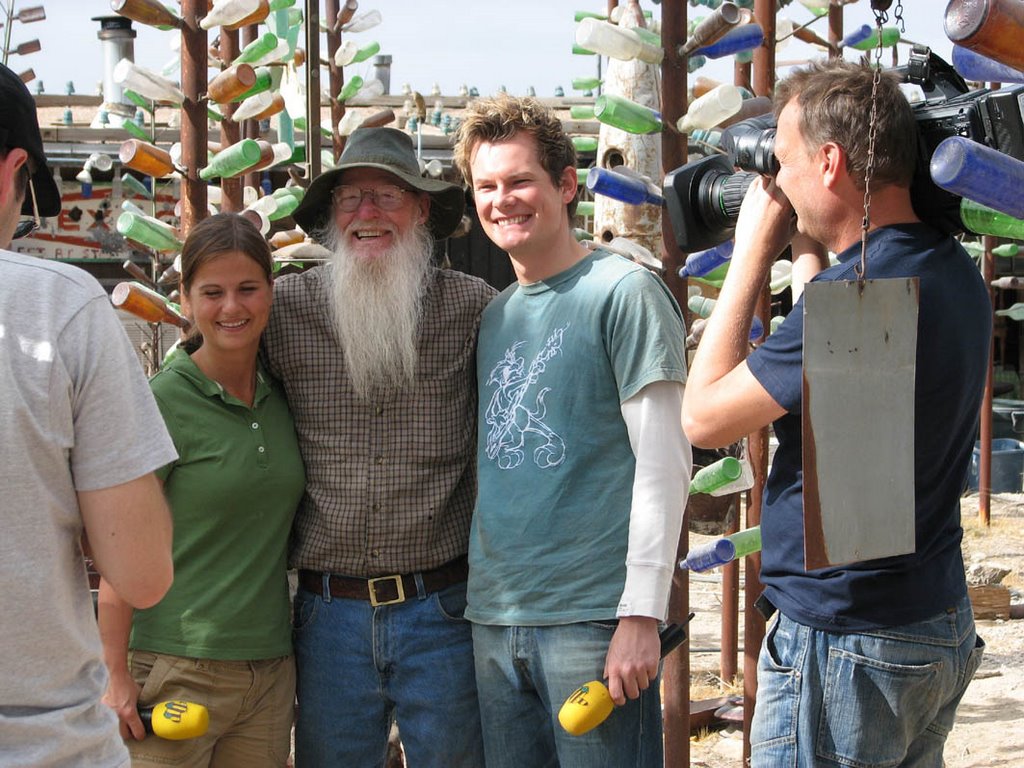
A german Television show stopped by and ran a couple of interviews. They were incredibly friendly and hospitable. The name of the television show escapes me at this time I will post as soo as I find it.
Also! The Bottle Man is in a movie! -- Desert Dreamers -- Narrated by Peter Fonda, Take a look at the website here You can also view the IMDB movie page Here
Thursday, August 17, 2006
Back again
Well it's been a few months since the last post. Here to dropoff a few more links for everyone to enjoy.
Here is H19's Flickr Gallery of the bottle trees. Some of the best photos yet.
There is a new Podcast I had never heard before called the Route 66 Minute. Take a listen and learn more about the Bottle Trees
Great article from he Press Enterprise By Mark Muckenfuss
"I tell people, your mansion's inside of you," Long says, touching his chest. "Your house is where your heart is. If you let your house go to hell, well, you're finished." Read More
The Bottle Tree ranch made USA Today list of places to visit on Route 66
OC Weekly Forum thread on The Bottle Trees Of Oro Grande, Ca
OC Weekly Article by Michelle Green
Click the link for "More Photos" to see all The Photos from OC weekly. Photos by Steve Perez
Here is H19's Flickr Gallery of the bottle trees. Some of the best photos yet.
There is a new Podcast I had never heard before called the Route 66 Minute. Take a listen and learn more about the Bottle Trees
Great article from he Press Enterprise By Mark Muckenfuss
"I tell people, your mansion's inside of you," Long says, touching his chest. "Your house is where your heart is. If you let your house go to hell, well, you're finished." Read More
The Bottle Tree ranch made USA Today list of places to visit on Route 66
OC Weekly Forum thread on The Bottle Trees Of Oro Grande, Ca
OC Weekly Article by Michelle Green
Click the link for "More Photos" to see all The Photos from OC weekly. Photos by Steve Perez
Thursday, April 13, 2006
Links Links Links
Heres a collection for updated links to articles and pictures from the World Famous Bottle tree Ranch of Oro Grande, Ca
The Lope -- Awesome Bottle tree Pics
Awesome Picture of The Bottletree Man himself
Bottle tree Guru and his bottles
Some Nice Comments about the Bottle Trees
Other Examples of Bottletrees
Pretty Good Photos of of the Bottle Trees
Bottletree Pics on the Worldisround.com
Excellent write up and pics of the history of the Bottle trees
Daily Press Bottletree Article
Mark and Shirlee's Bottletree Pics
Now an Official attraction at Roadside america.com
Mike Johnsons Bottle tree pics
Chuck Mueller Write up of the Route 66 Bottle trees
RVtravel.com Bottle trees write up.
Richard Franke Bottle Tree Pics
The Lope -- Awesome Bottle tree Pics
Awesome Picture of The Bottletree Man himself
Bottle tree Guru and his bottles
Some Nice Comments about the Bottle Trees
Other Examples of Bottletrees
Pretty Good Photos of of the Bottle Trees
Bottletree Pics on the Worldisround.com
Excellent write up and pics of the history of the Bottle trees
Daily Press Bottletree Article
Mark and Shirlee's Bottletree Pics
Now an Official attraction at Roadside america.com
Mike Johnsons Bottle tree pics
Chuck Mueller Write up of the Route 66 Bottle trees
RVtravel.com Bottle trees write up.
Richard Franke Bottle Tree Pics
Thursday, February 16, 2006
The Bottletrees are on Home and Garden Television
Well we have all the info now as to when this segment will air on the Bottletrees. The episode will air on Home and Garden TV March 19, 2006 6:00 PM ET/PT.
"The road trip this week starts in California with a Bonanza enthusiast who loved the show so much, he re-created the set in his home! Next, we head to Maine, where we find a handbuilt mushroom castle filled with funky furniture. Then, in Deadwood, Ore., we take a ride through a scenic backyard garden on a rebuilt train. In Idaho, we check out an offbeat geodesic dome with a little country flair planted in the middle of a suburban neighborhood. Finally, back in California, we meet a man on Route 66 who has turned his collection of antique bottles into amazing yard art."
It's great to see these little things come to fruition, from a tiny newspaper clipping to a small segment on HGTV. These Bottle trees are located in Helendale, Ca in between Victorville and Barstow off of Route 66, so as you can imagine not too many people get to truly see what this project is all about. Hopefully many more people will be able to take a look at the Bottletrees by seeing this segment. If not well, they have plenty of time...sitting in a hole 4 ft deep and a foot and a half wide, these beautiful works of art will be here for a long, long time.
"The road trip this week starts in California with a Bonanza enthusiast who loved the show so much, he re-created the set in his home! Next, we head to Maine, where we find a handbuilt mushroom castle filled with funky furniture. Then, in Deadwood, Ore., we take a ride through a scenic backyard garden on a rebuilt train. In Idaho, we check out an offbeat geodesic dome with a little country flair planted in the middle of a suburban neighborhood. Finally, back in California, we meet a man on Route 66 who has turned his collection of antique bottles into amazing yard art."
It's great to see these little things come to fruition, from a tiny newspaper clipping to a small segment on HGTV. These Bottle trees are located in Helendale, Ca in between Victorville and Barstow off of Route 66, so as you can imagine not too many people get to truly see what this project is all about. Hopefully many more people will be able to take a look at the Bottletrees by seeing this segment. If not well, they have plenty of time...sitting in a hole 4 ft deep and a foot and a half wide, these beautiful works of art will be here for a long, long time.
Friday, December 23, 2005
A new picture for the holidays

Just a quick picture that were taken a ways back. You can also click on the link on the right side menu to see more bottle tree pictures. Also I found another Route 66 trip write up here where they mention the Bottle trees.
Friday, November 25, 2005
How did all of this really begin?
My earliest memories carry me back to about 1951 or 52 when dad and I took trips together. In those days we just slept in the car. Him in the front seat and me in the back. Eventually we both became scavengers. In our travels we would find old dumps which were just filled with material which had been cast off as junk. Dad finally focused on looking for old bottles. He collected for about twenty years and was very successful. All of his trips were painstakingly documented. I still have all of his old maps which are clearly marked with pencil.
Around 1963 I found other interests, girls and cars. Then in 1964, four years of military. Two years after the military I wandered up into the Mojave Desert, my old stomping ground. I found a job, a wife, and eventually three boys. As a family we did pretty much the same thing my dad and I had done.
At age 50 my place was littered with material some of which was a hundred or more years old. I had a building full of it. For me the turn around came after visiting my parents one week end. Dad had put all his old bottles in trash cans and he had about lost all interest in all the things he had collected. He ended up giving me what he had. Well between what he had given me and what I had amassed over the years it all at once became overwhelming.
One thing kind of stuck in my craw that weekend when pulling those bottles out of trash cans. Dad had no way of displaying or sharing what he had found. His interest lay in only the challenge of locating and the collecting. Once a person has collected the interest that lays in just posessing usually will fade. One day I put some of the bottles on a wooden post similiar to an old place which was called hula-ville. The next morning when the sun rose I was hooked. The light of the sun intensified the brilliance of the colors in the bottles. I had only put up six or seven of these things when it came to me. Now I had a place to put every dammed thing I had ever collected.
One day I looked out front and someone was photographing. At the age of 55 I retired so that all my time could be devoted to this project. I have met and communicated with hundreds of people from all over the world. Not bad for a kid who started out sleeping in the back seat of a car. Later I'll post some stories.
Around 1963 I found other interests, girls and cars. Then in 1964, four years of military. Two years after the military I wandered up into the Mojave Desert, my old stomping ground. I found a job, a wife, and eventually three boys. As a family we did pretty much the same thing my dad and I had done.
At age 50 my place was littered with material some of which was a hundred or more years old. I had a building full of it. For me the turn around came after visiting my parents one week end. Dad had put all his old bottles in trash cans and he had about lost all interest in all the things he had collected. He ended up giving me what he had. Well between what he had given me and what I had amassed over the years it all at once became overwhelming.
One thing kind of stuck in my craw that weekend when pulling those bottles out of trash cans. Dad had no way of displaying or sharing what he had found. His interest lay in only the challenge of locating and the collecting. Once a person has collected the interest that lays in just posessing usually will fade. One day I put some of the bottles on a wooden post similiar to an old place which was called hula-ville. The next morning when the sun rose I was hooked. The light of the sun intensified the brilliance of the colors in the bottles. I had only put up six or seven of these things when it came to me. Now I had a place to put every dammed thing I had ever collected.
One day I looked out front and someone was photographing. At the age of 55 I retired so that all my time could be devoted to this project. I have met and communicated with hundreds of people from all over the world. Not bad for a kid who started out sleeping in the back seat of a car. Later I'll post some stories.
Thursday, November 24, 2005
The Bottle tree man

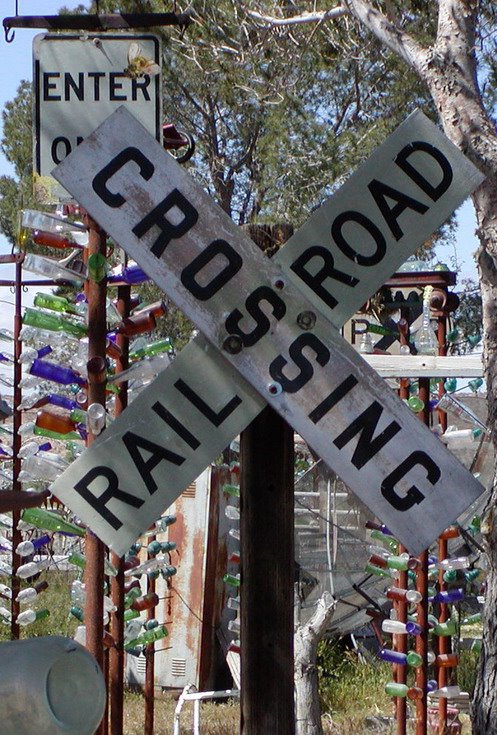
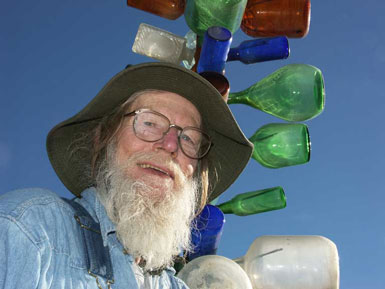
Every now and then a piece of art catches your eye. Today that art is the bottle tree for artist Elmer long of Oro Grande, Ca. These designs are 1 of a kind and virtualy impossible to replicate. Not just because the bottle are from the for corners of the earth or that the antiques that adorn the tops of the "trees" are priceless memories from the past. No the mystiqe lies in the artistry displayed by this eccentic artist. As we update this blog and track the progress of this incredible piece of work We'll be posting more pictures, trip reports of excursions to find more bottles. And the occasional Interview with the Bottle man himself. Enjoy a few pictures that we have uploaded today. Happy Thanksgiving.